Mix cameras and guests into an interactive live stream.
Cameras and guests connect in a shared WebRTC lobby, where their video feeds are mixed into a single live stream. Shig is open-source software for interactive live streaming, built for the Fediverse.
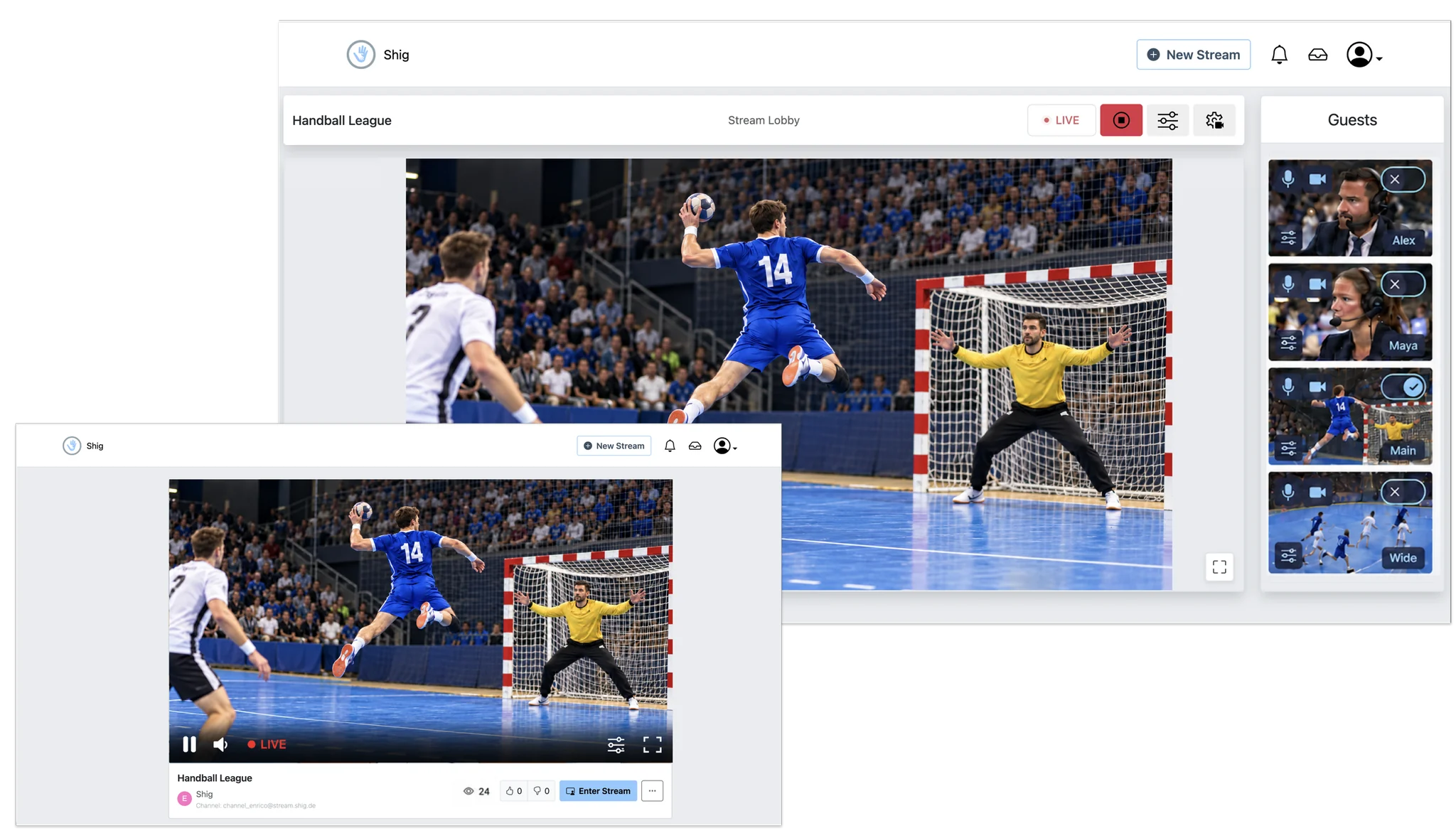
Background photo by Alina Grubnyak on Unsplash
Interactive Live Streaming
Shig combines WebRTC and Media over QUIC for real-time, interactive live streams. This enables use cases such as webinars and live event broadcasts with minimal setup.
Federation through ActivityPub
ActivityPub connects Shig with other platforms in the Fediverse, allowing communities to discover and share live events across independently operated instances.
Scale for your community, not the entire Fediverse.
Both Shig’s lobby and its media relay servers work with other instances, sharing the load across the network so each instance only needs to support its own community. Your instance serves its own users using its own resources.
Technology
Media over QUIC as a WebRTC stream fan-out
Shig’s core consists of two parts. The lobby receives streams via WebRTC and works like a video conference, allowing different sources to be mixed and participants to interact in real time. The mixed stream is then distributed from the lobby to a large audience via Media over QUIC, in near real time. Viewers can join the lobby and become part of the live stream, moving from watching to participating.
WebRTC lobby · Media over QUIC · Relay servers · Live audience
Decentralized cascading
The SFU is designed for decentralized cascading from the ground up. Its signaling relies entirely on HTTP rather than stateful signaling connections such as the WebSockets commonly used in centralized conferencing systems. The lobby state is decentralized and distributed by design, allowing users from different instances to join the same lobby through their respective SFUs.
Roadmap
-
Foundation
The basic setup for live streaming and running a community server.
- A WebRTC lobby, live mixing and stream distribution through Media over QUIC.✓ Done
- An admin dashboard for managing the community server.✓ Done
- A channel dashboard where users can manage their channels and view their live streams.✓ Done
- Admin controls for allowing or disabling user logins.✓ Done
- Two-factor authentication.Planned
- Admin-controlled registration.Planned
- Current live viewer count.In progress
-
Federation
In progressConnect Shig with the Fediverse through ActivityPub so live events can be discovered and shared across platforms.
- Integration of Lemmy’s ActivityPub library.In progress
- Monitoring of federated servers.In progress
- Search for and manage federated servers in the admin dashboard.In progress
- Persistent storage of live stream recordings in PeerTube.Planned
-
Distributed streaming
Connect lobbies and media relays across instances through cascading, with each instance serving its own community.
- Cascading WebRTC lobbies across instances.Planned
- Distributed streaming catalog.Planned
- Distributed stream delivery through cascading media relays.Planned
- Media watermarking for live streams.Planned
- End-to-end encryption.Planned
-
Bot-resistant community
PlannedDevelop ontology-based bot detection to help identify automated accounts and protect the community from bots.

Shig: distribute and clone live streams among Fediverse instances
Talk at FOSDEM 2024
In the talk at FOSDEM’24, we demonstrated how interactive live streaming is possible within the Fediverse. Towards the end, it became evident how crucial bandwidth estimation is, and this will be the next major feature in Shig.
Watch the talk